2026-02-10
A Guide to Meeting Transcription Services for Teams
Let’s be real for a moment: how many meetings have you walked out of (or logged off from) feeling like you just produced more questions than answers? A few days later, the details get fuzzy. Who was supposed to handle that follow-up? What was the final call on the Q3 budget? It’s a familiar struggle, and that constant mental scramble to recall specifics is a massive productivity killer.
This is why manual note-taking just doesn't cut it anymore. It forces at least one person to be half-present, splitting their focus between contributing ideas and furiously typing to keep up. Inevitably, key nuances, exact quotes, and brilliant off-the-cuff suggestions get missed. What you're left with is a single, often biased, set of notes that barely scratches the surface of the actual conversation.
A Smarter Way to Capture Conversations
This is exactly where modern meeting transcription services step in. Don't just think of them as simple recorders; they're more like an intelligent assistant for your team's collective brain. They tackle the problems of forgotten details and divided attention head-on by creating a perfect, unbiased record of every single word.
With the massive shift to remote and hybrid work, this kind of tool has become essential. We're having more critical conversations over video calls than ever before. Yet, nearly 60% of remote workers admit they have a hard time remembering important information from those calls. Productive discussions quickly turn into missed opportunities.
In a world built on virtual collaboration, letting valuable conversations simply vanish is a huge business risk. A solid transcript turns a fleeting discussion into a permanent, searchable, and shareable asset.
The Business Case is Clear
The explosive growth in this space tells the whole story. The market for AI meeting transcription is expected to jump from $3.86 billion in 2025 to a staggering $29.45 billion by 2034—that's a 25.62% compound annual growth rate. This isn't just a fleeting trend; it’s a fundamental change in how high-performing teams work.
The cost of not adopting this technology is staggering. Inaccurate data from sloppy notes costs companies an average of $12.9 million every year due to errors and forgotten action items. You can see more data on AI transcription's growth on brasstranscripts.com.
AI-powered transcription services essentially eliminate that risk by delivering a reliable, word-for-word record. They give your team:
- A Perfect Memory: Need to find a specific decision or comment? Just search for it. No more re-watching an hour-long recording.
- Full Engagement: Everyone can participate fully in the conversation, leading to better ideas and deeper collaboration.
- Greater Accessibility: Transcripts are a lifeline for people who missed the meeting, have hearing impairments, or are working in different time zones.
- Crystal-Clear Accountability: You can easily confirm who owns what task, which keeps projects moving forward without confusion.
At the end of the day, these services aren't a luxury anymore—they're a competitive must-have. They provide the solid foundation you need for clear communication, smart decisions, and real productivity.
How AI Actually Listens In and Transcribes Your Meetings
Ever sat through a chaotic team meeting and wondered how a piece of software could possibly turn it into a clean, readable document? It’s not magic, but it’s a fascinating process. Think of it less like a single tool and more like a multi-step digital assembly line, where raw sound is transformed into intelligent text.
It all starts with capturing the audio from your meeting. The system records everything—every "um," every cough, and every game-changing idea—as a raw digital audio file.
This is where the heavy lifting begins. That audio file is fed into an engine powered by Automatic Speech Recognition (ASR). This is the core technology that translates spoken words into written text.
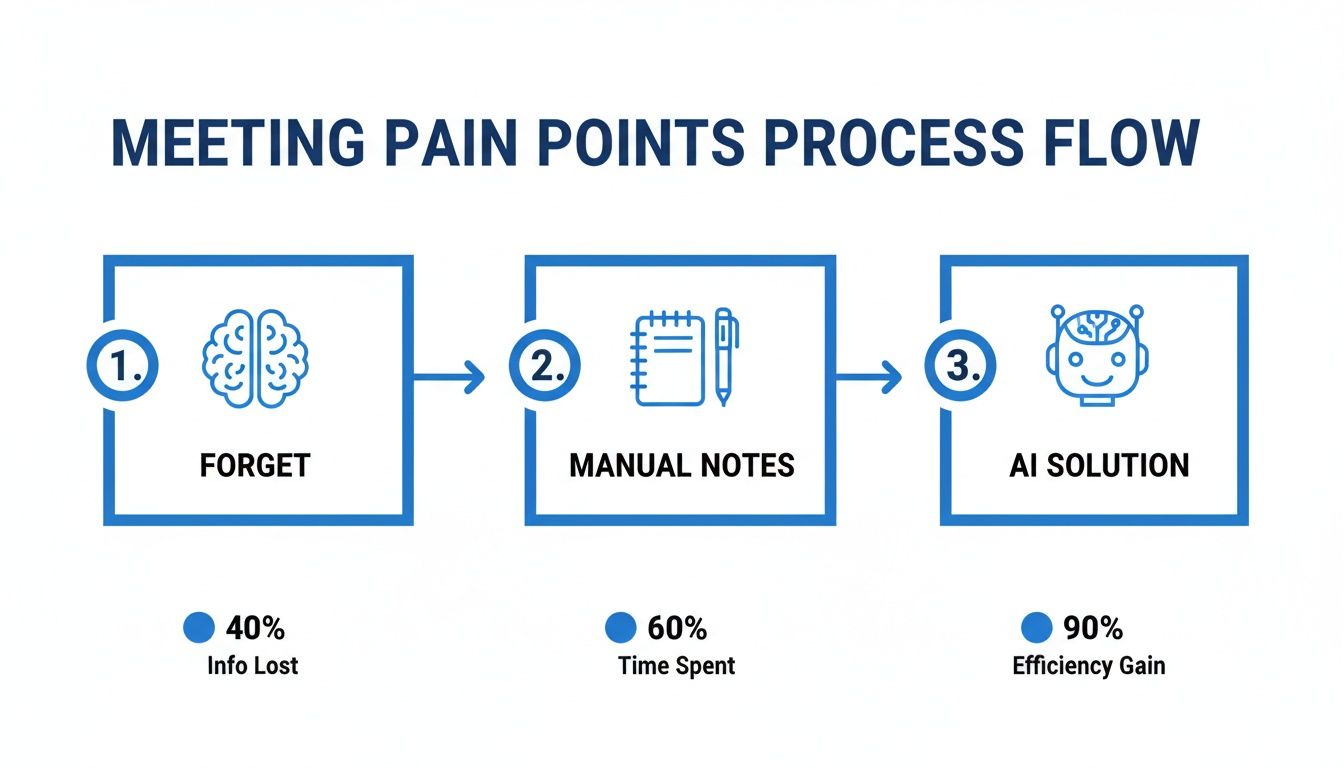
This whole workflow is designed to solve some very common meeting frustrations.
As you can see, it’s about moving past the struggle of forgetting details and the chore of taking notes by hand, and into a much smarter, automated process.
From Sound Waves to Sentences
So, what is ASR actually doing? The AI model has been trained on millions of hours of human speech, learning to identify the tiny sound units (called phonemes), words, and sentence patterns we use every day. It chops your meeting's audio into tiny segments, analyzes each one, and makes a highly educated guess about what was said.
This is way harder than it sounds. The AI has to deal with real-world complexities like:
- Different Accents: Telling the difference between regional and international ways of speaking.
- Speech Patterns: Keeping up with fast talkers, slow talkers, and changes in tone.
- Background Noise: Ignoring keyboard clicks, a distant siren, or a coworker's side chat.
Older ASR was pretty clunky, but today’s AI models are incredibly sophisticated, often hitting over 95% accuracy when the audio is clear.
Adding Meaning and Identifying Speakers
A giant wall of text isn't very useful. To make the transcript practical, a couple more layers of intelligence are added.
First, Natural Language Processing (NLP) steps in to figure out the meaning and structure behind the words. It looks at grammar and context to add punctuation, create paragraphs, and make the text readable. This is what turns a long, rambling sentence into something you can actually understand.
Next, a clever technology called speaker diarization gets to work. It analyzes the unique vocal signatures—like the pitch and tone—of each person speaking. This allows the system to label the text with who said what, like "Sarah:" or "David:".
When it all comes together, a messy, overlapping conversation becomes a structured, searchable, and genuinely useful record. It’s a remarkable journey from raw sound to actionable information.
Tackling Real-World Challenges
Of course, no meeting is perfect. People talk over each other, use niche industry jargon, or join calls from different countries.
This is where the best transcription services prove their worth. Top-tier platforms like Kopia.ai are constantly training their AI models on diverse sets of data to get better at handling accents and technical terms. Many also offer transcription in dozens of languages, which is a huge advantage for global teams. You can see just how versatile these tools can be when you explore the .
The goal is simple: to give your team a clear and accurate record, no matter who is talking or what they're talking about.
Key Features That Define a Great Transcription Service
Not all meeting transcription services are created equal. Sure, most can turn spoken words into text, but the standout platforms offer a whole suite of features that can turn a simple transcript into a productivity powerhouse. To pick the right service, you need to know what to look for beyond just basic accuracy.
The best tools don't just give you a wall of text; they create an intelligent, interactive experience that makes it dead simple to find what you need.
Interactive and Searchable Transcripts
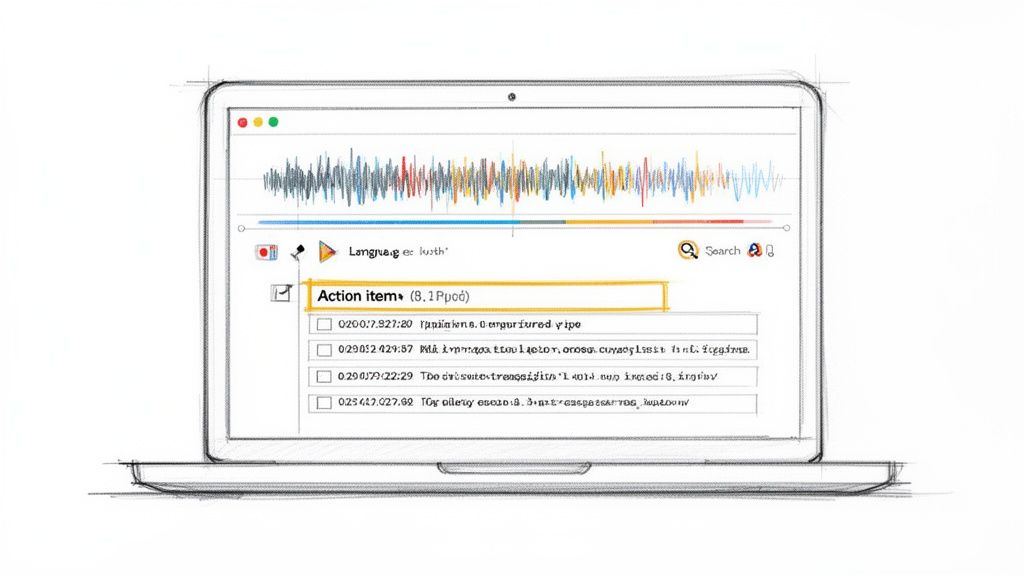
A static block of text is only a small step up from scribbling notes by hand. A truly great service gives you an interactive transcript, where every word is perfectly synced to the audio or video recording. This means you can click on any phrase in the text and instantly jump to that exact moment in the meeting.
This is a complete game-changer for editing and pulling out key moments. Forget scrubbing back and forth through an hour-long recording to find one specific quote. Now you can find it in seconds, making it easy to correct a name, clarify a point, or grab a soundbite for a marketing video.
Accurate Speaker Identification
A transcript without clear speaker labels is just a confusing mess of unattributed ideas. Basic services often struggle here, but more advanced platforms use a technology called speaker diarization to automatically and accurately figure out who is talking.
This is absolutely essential for accountability. When you're reviewing a meeting, you need to know who agreed to that deadline or who came up with that brilliant strategy. Clear labels like "Sarah:" and "David:" make the entire conversation easy to follow, ensuring nothing gets lost in translation.
Multi-Language Support and Translation
In today's global workplace, teams are spread across different countries and languages. A top-tier transcription service has to be able to handle that. Look for platforms that can accurately transcribe dozens of different languages, so you get a clear record no matter who is on the call.
The best services go a step further and offer built-in translation. A tool like Kopia.ai, for example, can transcribe a meeting in English and then translate that text into over 100 other languages with a single click. This is huge for making your content accessible to an international audience or just keeping your global teams on the same page.
A truly great transcription service breaks down communication barriers. It doesn't just record what was said; it makes that information accessible and understandable to everyone, everywhere.
Subtitle and Caption Generation
If you create any kind of video content from your meetings, webinars, or interviews, automatic subtitle generation is a must-have. Manually typing out captions is an incredibly tedious and time-consuming chore.
A powerful transcription tool can generate subtitle files (like SRT or VTT) for you automatically. Some even let you "burn" the captions directly onto your video, saving you hours of post-production work. This not only makes your videos more accessible but also gives your SEO a nice boost, since search engines can read the text in your captions.
AI-Powered Summaries and Insights
Let's be honest: the whole point of transcription is to save time, not to create more reading for yourself. This is where AI-powered analysis comes in. The most modern services are moving beyond just word-for-word text to provide you with smart summaries of your meetings.
Imagine getting a concise, automated overview of a long discussion that highlights the key topics, action items, and major decisions. This feature lets you get the gist of an entire meeting in minutes instead of wading through pages of transcript. If you want to see how AI is making transcripts genuinely useful, you can explore tools that turn your .
To help you see the difference, here’s a quick look at what separates a basic service from a more advanced one.
Feature Comparison for Meeting Transcription Services
| Feature Category | Standard Offering (Basic Services) | Advanced Offering (Like Kopia.ai) |
|---|---|---|
| Transcript Editor | Basic text editor with limited functionality. | Interactive, synchronized editor; click text to jump to the audio point. |
| Speaker Labeling | May require manual labeling or offer generic "Speaker 1, Speaker 2." | Accurate, automatic speaker identification with customizable names. |
| Language Support | Limited to English or a few major languages. | Transcription in 80+ languages and translation into 130+ languages. |
| Export Options | Basic text or Word document exports. | Multiple formats including SRT, VTT for subtitles, plus PDF and TXT. |
| AI Analysis | None or very basic keyword detection. | Automated summaries, chapter creation, topic detection, and action items. |
As you can see, the gap between a standard tool and an advanced one is significant. While a basic service gives you the raw text, an advanced platform provides a full suite of tools designed to help you understand, share, and act on your meeting content more effectively.
How Different Industries Use Transcription Services
Meeting transcription services aren't just a fancy way to take notes. They're a powerful tool that delivers real, measurable results in a whole range of fields. To really see their value, you have to look past the tech and see how actual professionals are putting them to work every day, turning spoken words into something they can actually use.
The basic idea is simple: get a perfect, searchable record of what was said. But how that record gets used is where things get interesting.
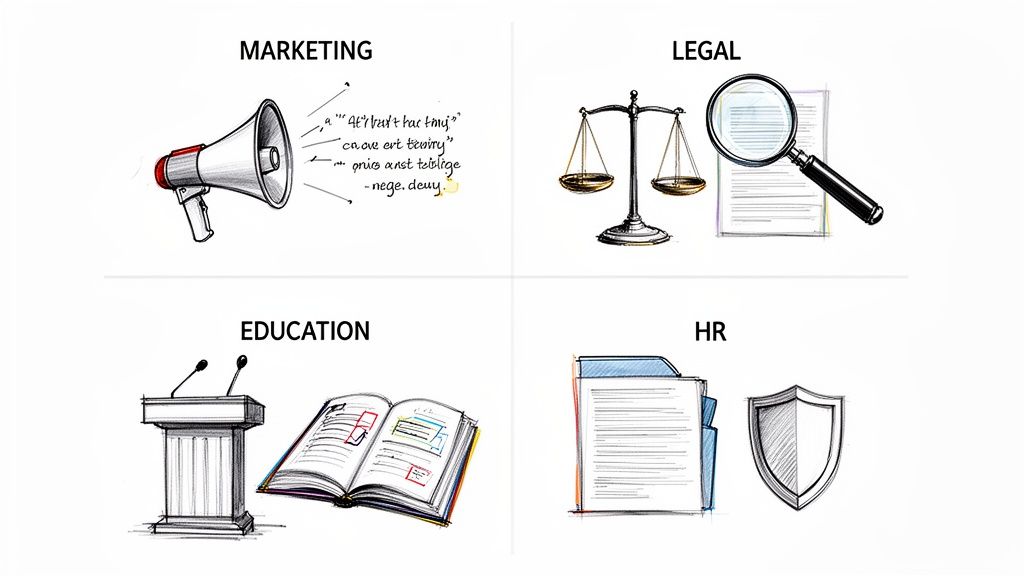
For Marketing and Product Teams
Marketing and product teams live and breathe customer feedback. Think about it: they run endless interviews, focus groups, and user tests to figure out what people really want. Trying to find that one game-changing quote by scrubbing through hours of audio recordings is a soul-crushing task.
This is where transcription services flip the script. A marketing manager can search through a dozen customer interviews for a keyword like "frustrating" or "love this feature." Suddenly, they've got a pile of authentic customer quotes ready for a new ad campaign in minutes, not days.
- Product Managers: They can spot recurring feature requests or common bugs by analyzing user feedback transcripts, giving them hard data to build a better product roadmap.
- Content Marketers: A single webinar or podcast can be instantly repurposed. With a clean transcript, it’s easy to pull out snippets for social media, write a detailed blog post, or build a case study.
It gives them a direct line to the voice of the customer, which is pure gold for building products and campaigns that people actually care about.
For Legal and Compliance Professionals
In the legal field, there’s zero room for error. Every single word in a deposition, client meeting, or witness interview matters. Taking notes by hand isn't just slow—it's a huge risk.
Legal teams rely on transcription services to create a flawless, word-for-word record of every important conversation. This ensures nothing gets lost in translation or forgotten. A paralegal can search a three-hour deposition for every mention of a key piece of evidence, saving them an unbelievable amount of time.
For any industry with strict regulations, having an accurate, time-stamped transcript isn't a nice-to-have. It's fundamental for compliance and managing risk.
These searchable records are also critical for:
- Ensuring Compliance: HR can keep precise records of disciplinary meetings or internal investigations, making sure they’re following company policy and labor laws to the letter.
- Litigation Support: Lawyers can build case timelines, prep witnesses, and pinpoint contradictions by referencing exact statements made months or even years earlier.
- Contract Negotiations: A clear transcript of verbal agreements made during negotiations helps prevent disputes down the line and clarifies what everyone agreed to.
For Educators and Researchers
In education and research, it’s all about sharing knowledge and making it accessible. Transcription services are making a huge difference in both areas.
A professor can record a lecture and give students the full transcript. This is a game-changer for students with hearing impairments or for those learning in a second language. It also means anyone can review a complex topic at their own speed without having to re-watch a two-hour video.
Researchers doing qualitative studies also see massive benefits. Imagine transcribing 50 in-depth interviews. With the text, they can search for themes and patterns in the data far more effectively than just by listening. It makes the whole process of analyzing information faster and much more rigorous.
From marketing to law to the classroom, the story is the same: meeting transcription turns fleeting conversations into permanent, searchable knowledge that helps teams work smarter, faster, and with more accuracy.
Understanding Security and Data Privacy
Let's be blunt: when you use a meeting transcription service, you're handing over a recording of your internal conversations. This isn't just small talk; it could be sensitive client details, your next big business strategy, or confidential company data. This is why top-notch security isn't just a nice-to-have feature—it's the absolute baseline.
Think about it like choosing a bank. You wouldn't leave your money with a bank that props its vault door open, right? In the same way, you shouldn't upload your private meetings to a platform that plays fast and loose with data security. A single breach could leak trade secrets, break client confidentiality, and torpedo your company's reputation.
The Non-Negotiables of Data Protection
Protecting your conversations boils down to strong technical safeguards, and the most crucial one is end-to-end encryption. This basically acts like a sealed, armored truck for your data. It scrambles the audio file on your device and ensures it can only be unscrambled by the service's secure servers, making it completely unreadable to anyone trying to snoop on it in transit.
On top of that, your data must be encrypted at rest. This just means that once your file is sitting on the provider's servers, it's stored in a protected, scrambled format. So, even if someone managed to physically access the server, your data would be a useless jumble of code to them.
Choosing a service without strong encryption is a huge gamble. Your confidential discussions become an open target, and you completely lose control over who sees that sensitive information.
Compliance with Global Regulations
Data privacy isn't just good practice anymore; it's the law. Major regulations like the General Data Protection Regulation (GDPR) in Europe and the California Consumer Privacy Act (CCPA) have set firm rules for how companies must handle personal data. Any transcription service worth its salt must be fully compliant.
What does compliance actually mean for you? It means the provider is committed to:
- Data Minimization: Only collecting the data they absolutely need to get the job done.
- User Control: Giving you the power to access, edit, and permanently delete your own data.
- Transparency: Being upfront and clear about what data they collect and how they use it.
Sticking with a compliant service keeps you out of legal hot water and ensures your data is handled according to global standards. You can usually get a good sense of a provider’s stance by reading their policies, like this clear breakdown of .
Your Security Checklist Before You Choose
Before you sign up for any service, you need to ask some tough questions. A provider who takes this stuff seriously will have clear, confident answers ready.
- Is my data encrypted both in transit and at rest? This is non-negotiable. The answer must be a simple "yes."
- Are you compliant with major data regulations like GDPR? This shows they are serious about privacy and respect user rights.
- Who actually has access to my data? The best policies severely restrict any internal employee access to your files.
- How long is my data stored, and can I delete it myself? You should always have full control to wipe your information from their servers for good.
Getting these questions answered will quickly help you weed out the services that don't make the cut, so you can feel confident that your private conversations stay private.
Choosing the Right Meeting Transcription Service
With so many transcription tools out there, picking the right one can feel a bit like spinning a wheel. How do you know which one is actually worth the investment?
The trick is to ignore the flashy marketing and focus on what your team truly needs to get work done. A good choice now means you’ll have a tool that supports your team for the long haul, not one you’ll be looking to replace in six months.
Start by getting really clear on your own needs. Don't just pick the service with the most bells and whistles. Think about what you'll actually do with the transcripts. Are you just looking for quick summaries to share? Or do you need detailed, searchable records for compliance and analysis? Your answer changes everything.
Your Buyer's Checklist
To cut through the noise, you need a solid game plan. This checklist will help you evaluate potential services based on what really matters, ensuring you end up with a tool that provides genuine value from day one.
First up, accuracy. Most AI services claim 90% or higher accuracy, but the real world is messy. Background noise, heavy accents, and industry-specific jargon can trip up even the best algorithms. The only way to know for sure is to test it. Take a recording of a typical meeting and run it through a free trial to see how it holds up.
Next, let's talk about money. Does the pricing make sense for how you'll use it? Some platforms charge by the minute, which can get expensive fast. Others have monthly or annual subscriptions. If your meeting schedule is unpredictable, you need a plan that can adapt. A service like , which offers different tiers for individuals and businesses, gives you the flexibility to scale without overpaying.
A great transcription service should feel like a natural extension of your workflow, not another complicated tool you have to fight with. The goal is to save time and mental energy, not create more of it.
Finally, think about how this tool will fit into your existing setup. A standalone transcription app is fine, but one that plugs right into the software you already use is a game-changer. Look for integrations with tools like , , or your favorite project management app. When transcripts and action items flow seamlessly between platforms, the tool becomes part of your team's natural rhythm.
Here are the key questions to ask as you compare your options:
- Accuracy and Editing: How good is the initial transcript, and how painful is it to clean up? A must-have feature is an interactive editor that syncs the text with the audio, making corrections a breeze.
- Integrations: Does it play nice with the other software your team relies on? This is huge for getting everyone on board and actually using the tool.
- Pricing Scalability: Does the cost make sense for your team today and a year from now? Avoid getting locked into a plan that's too big or too small.
- Customer Support: What happens when something goes wrong? Knowing you can get a quick, helpful answer from a real person is more important than you think, especially when you're facing a deadline.
By walking through these points, you can move past the sales pitches and confidently select a service that fits your budget, workflow, and goals.
Frequently Asked Questions
Let's clear up some of the most common questions people have about meeting transcription services. We'll get into the practical stuff—like accuracy, language support, and how these tools play with others—to help you get a clearer picture.
How Accurate Are AI Transcription Services?
This is the big one, and the honest answer is: it depends on how clean your audio is.
If you have a recording with clear speakers, minimal background noise, and no one talking over each other, the best services can hit 95% accuracy or even higher. That’s more than good enough for reliable meeting notes, video subtitles, and pulling out key action items.
But real-world audio is messy. Things like strong accents, industry-specific jargon, or just a bad laptop microphone can knock that number down. This is where top-tier platforms like Kopia.ai really shine, as they constantly improve their AI to handle these challenges. A must-have feature is an editor that links the text directly to the audio, so you can quickly listen and fix any mistakes in a snap.
Do These Services Work With Multiple Languages?
Absolutely, and for global teams, this is a game-changer. While some basic tools might stick to just English, the more sophisticated services offer fantastic multilingual support. It's not uncommon to see platforms that handle dozens of languages, from Spanish and French to Japanese and Mandarin.
The real magic happens when they add translation into the mix. Imagine transcribing a meeting that was held in English and then, with a click, translating that entire transcript into over 100 other languages. It’s a powerful way to keep international team members in the loop and make your content accessible to a much wider audience.
The real power of a great transcription service isn’t just capturing words—it’s breaking down communication barriers. By supporting multiple languages, these tools ensure everyone on your team has access to the same information, regardless of where they are.
What File Types and Integrations Are Supported?
Flexibility is key, and most services are built with that in mind. You can usually upload all the standard audio and video formats, like MP3, MP4, WAV, and MOV. Once the work is done, you’ll want to be able to export the text in a format that works for you. Look for options like:
- Plain Text (.txt): Perfect for quick copy-pasting.
- Word Documents (.docx): Great for more formal reports or notes.
- Subtitle Files (.srt or .vtt): A must-have for anyone working with video.
Integrations are just as important. The best transcription tools connect directly to the software your team lives in every day, whether it's Slack, Notion, or your favorite project management app. This creates a seamless flow, letting you share transcripts and assign action items without constantly jumping between different browser tabs.
Ready to turn your conversations into actionable, searchable assets? Kopia.ai offers fast, accurate transcription in over 80 languages, with an intuitive editor and powerful AI summaries to save you time.